Highlights
A puzzle game I first wrote for Android years ago and recently ported to p5.js. Every tile hides a digit and its color is your only clue. You crack a target code by tapping the tiles whose colors map to its digits, all while the board keeps sliding its rows and columns under you. It ramps up as new shapes appear, the grid grows, codes run longer, and some digits start wearing more than one color.

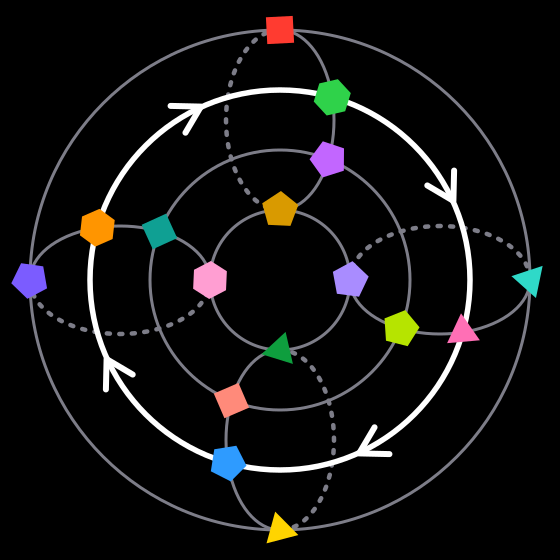
Every row and column wraps around, so a tile that slides off one edge comes back on the other. The diagram unrolls that into rings for the rows and ellipses for the columns. The highlighted ring and arrows reflect the grid row which is shifting from left to right.
An endless side-scroller I first wrote in Processing years ago and recently ported to p5.js. You keep a spinning ball alive between two walls while boxes and holes scroll past, and every level throws in a new twist like reversed gravity or walls closing in.

It is not very optimised, it is just an old favorite I wanted to keep around. The game also keeps high scores stored locally via localStorage (no backend logic).
My very first post here is the beginning of a series of posts where we build a particle visualisation from the ground up. in this first part of the series we discuss modeling choices and iterate over a basic implementation towards better performance, with all computations running on the CPU. In part two we will dig deeper into maintaining a high framerate while increasing the number of particles using more advanced techniques and concepts such as space partitioning, web workers, and more! Here's a brief look at what this series of posts is all about
This is however a GPU accelerated version of the final simulation which will be covered in part two, yet I thought it would be a nice demo to give you a taste of what the final result could look like!
This album is where you can check out some examples of my black and white photographs such as this one which is one of my personal favorites

There is just something magical about forests in a foggy weather. even without colors it's there, and I love it.
There are no sub-categories yet so the album is a mix of mostly urban shots, iPhone photos, and some photographs from my hikes. the one above is from a foggy morning hike near Kochelsee.